3-Tab vs Architectural Shingles: Cost Comparison for 2026
3-tab vs architectural shingle cost comparison for 2026: price per square, lifespan, wind resistance, and when 3-tab is still the right call.
Architectural shingles have become the default recommendation on most residential roofing bids, and for good reason: better wind resistance, a longer warranty, and a dimensional look homeowners generally prefer. But 3-tab shingles haven’t disappeared from the market, and there are still situations where they’re the right call rather than just the cheap one.
3-tab shingles installed run $300-$400 per square. Architectural shingles run $350-$450 per square. That’s a $50-per-square gap on average, which on a 20-square roof works out to roughly $1,000 difference for the full job. Whether that gap is worth closing depends on the homeowner’s timeline, budget, and how long they plan to stay in the house.
What’s actually different between them
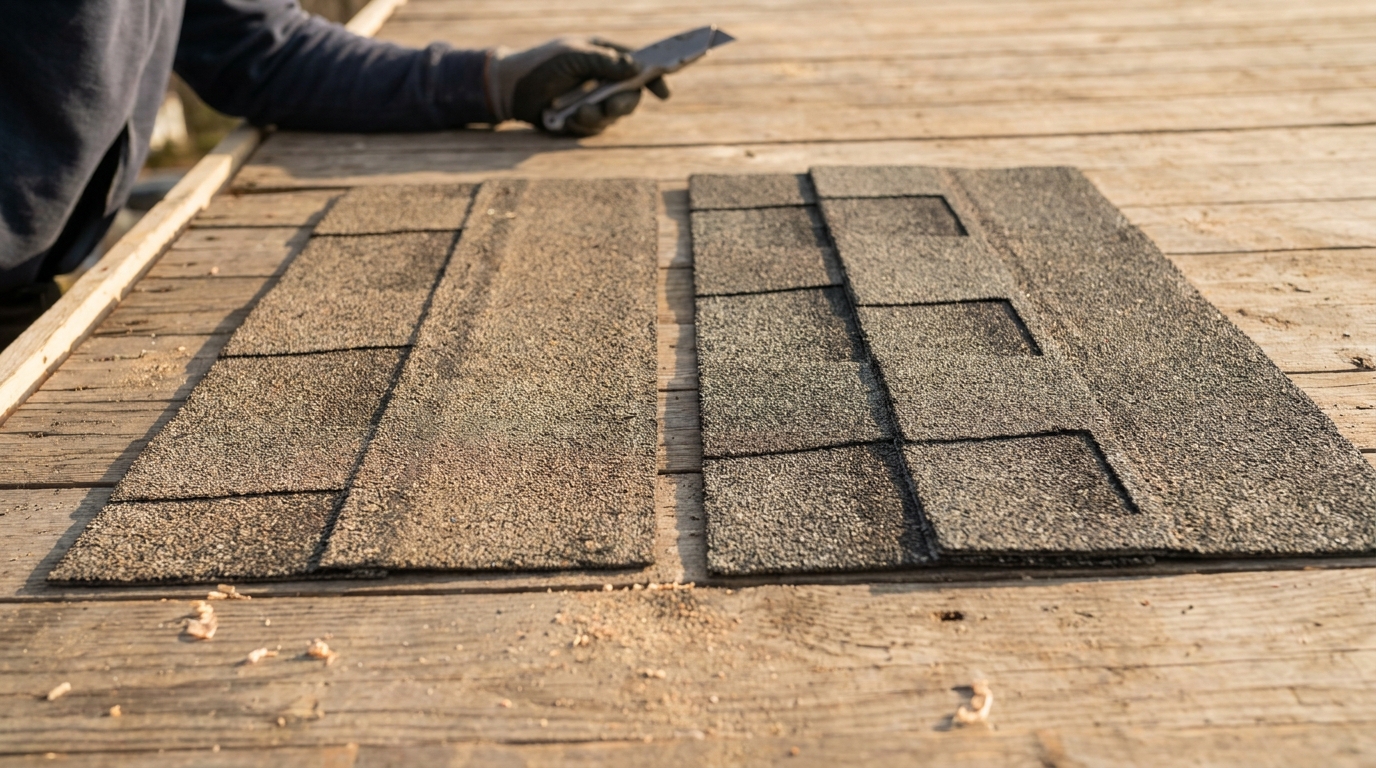
3-tab shingles are flat, single-layer, and uniform, cut with tabs that create the classic three-slot shingle pattern. They’re lighter, simpler to manufacture, and have been the standard roofing material for decades.
Architectural shingles (sometimes called dimensional shingles) are laminated, with multiple layers bonded together to create a thicker, textured, more three-dimensional appearance. That extra material is also what gives them better wind resistance and a longer usable life.
The manufacturing difference translates directly into performance differences that matter for the bid.
Comparing the numbers
Material and installed cost. 3-tab runs $300-$400 per square installed. Architectural runs $350-$450 per square installed. Premium or designer shingles, which are architectural shingles with heavier lamination and enhanced patterns, run $500-$700 per square.
Warranty and lifespan. 3-tab shingles typically carry a 20-25 year warranty. Architectural shingles typically carry a 30 year warranty, with premium products reaching 50 years or lifetime coverage. Real-world lifespan tracks reasonably close to the warranty figures in most climates, assuming proper installation and ventilation.
Wind resistance. 3-tab shingles are generally rated for winds up to 60-70 mph. Architectural shingles are typically rated for 110-130 mph, sometimes higher on premium lines. This is one of the more significant practical differences, especially in regions that see regular high wind events.
Weight and structural load. Architectural shingles weigh more per square than 3-tab, which is rarely an issue on a straightforward reroof but is worth confirming on older homes or unusual roof structures where load capacity might be a factor.
Appearance. 3-tab shingles have a flat, uniform look. Architectural shingles have a layered, textured appearance that reads as more expensive from the ground, which matters for curb appeal and resale.
Insurance considerations. In some markets, particularly ones prone to hail or high wind, insurers offer better rates or require class 3 or 4 impact-rated shingles, a category that only exists within architectural and premium product lines. This can shift the economics of the decision beyond just the upfront cost.
When 3-tab is still the right recommendation
There are legitimate reasons to spec 3-tab beyond just price, and it’s worth knowing them so the conversation with a homeowner doesn’t default to “architectural is always better.”
Rental properties and investment homes, where the owner’s time horizon is shorter and the priority is minimizing upfront cost rather than maximizing lifespan, are a reasonable fit for 3-tab.
Homes in a resale process where the roof needs replacing but the owner has no intention of staying long enough to benefit from a 30-year warranty sometimes make the same calculation.
Detached structures like sheds, garages, or outbuildings where appearance and longevity matter less than on the primary residence are also a common spot for 3-tab.
Outside of those situations, most roofers steer homeowners toward architectural, since the price gap is often smaller than people expect once it’s spread across the full job.
Pricing the difference for a homeowner
Take a straightforward 2,000 square foot home at 7/12 pitch, working out to roughly 24 squares after the pitch multiplier.
3-tab shingles at $350/square installed (mid-range) comes to $8,400 before any additional line items like tear-off, deck repair, or flashing.
Architectural shingles at $400/square installed comes to $9,600 for the same job.
The difference is $1,200 on a job of this size, for roughly 5-10 additional years of warranty coverage and meaningfully better wind performance. Framed as a monthly or yearly cost over the life of the roof, that gap tends to look smaller to homeowners than it does as a single upfront number, and it’s worth presenting it that way rather than just showing two total prices side by side.
What roofers get wrong when presenting this choice
Assuming the homeowner knows the difference. Most people searching for a roof replacement don’t know 3-tab and architectural are different products until someone explains it, and presenting both options with the reasoning behind each builds more trust than just quoting one.
Not mentioning wind rating in wind-prone regions. If a homeowner is in a market with real storm exposure, the wind resistance difference is often the more compelling argument than the warranty length, and it’s worth leading with.
Quoting 3-tab by default to win on price, without flagging that it may affect insurance eligibility or rates in markets where impact-rated shingles matter.
Treating the price gap as fixed. The dollar difference scales with roof size, so a small roof might only see a few hundred dollars of difference while a large one sees several thousand. Calculate it for the actual job rather than quoting a rule of thumb.
FAQ
Is architectural or 3-tab shingle cheaper?
3-tab is cheaper, running $300-$400 per square installed versus $350-$450 for architectural. The gap is usually a few hundred to about a thousand dollars on a typical home, depending on roof size.
How much longer do architectural shingles last than 3-tab?
Architectural shingles typically carry a 30-year warranty compared to 20-25 years for 3-tab, and real-world performance tends to track close to those figures with proper installation and ventilation.
Are architectural shingles worth the extra cost?
For most primary residences, yes. The combination of better wind resistance, longer warranty, and stronger curb appeal usually outweighs the price difference, especially once it’s spread across the size of a typical roof.
Can you still buy 3-tab shingles in 2026?
Yes, though fewer manufacturers produce them than a decade ago, and some markets have moved almost entirely to architectural. They remain available and are still a reasonable choice for specific situations like rental properties or outbuildings.
Do architectural shingles affect homeowners insurance?
In some regions prone to hail or high wind, insurers offer better rates for impact-rated shingles, a category that generally only includes architectural and premium products. It’s worth checking with the homeowner’s insurer if that’s a relevant factor in their market.
The short version
3-tab shingles cost less and still get the job done, but architectural shingles win on wind resistance, warranty length, and appearance for a price difference that’s usually smaller than homeowners expect once it’s calculated for their actual roof size. Present both options with real numbers rather than defaulting to one, and let the homeowner’s timeline and budget make the call.
SnapScope prices roofing jobs in either shingle type from your job site photos, so you can show a homeowner both options side by side before you’ve left the driveway.

SnapScope AI - Cost Estimator
Snap photos. Get instant estimates.
 Download SnapScope
 Or search "SnapScope AI" in the App Store
For the full 2026 rate table including pitch multipliers, see the roofing pricing guide, or read how much to charge for a roofing estimate for the complete estimating breakdown.