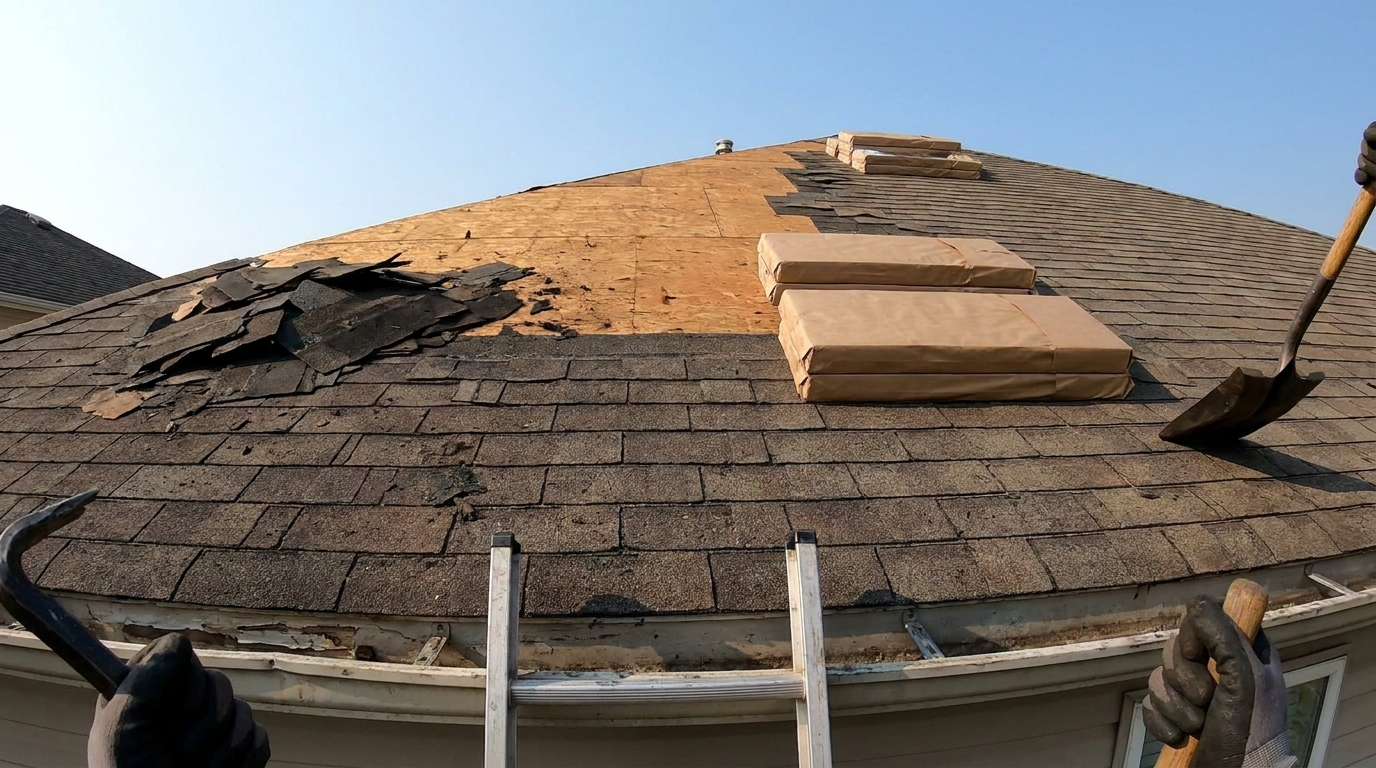
How Much to Charge for a Roofing Estimate in 2026
How to price a roof replacement accurately in 2026: shingle costs per square, pitch multipliers, tear-off, and a full worked example for a 2,000 sq ft home.
Roofing is priced by the square, meaning 100 square feet of roof surface, not the footprint of the house. That distinction trips up more new roofers than almost anything else in the estimate, because a homeowner’s 2,000 square foot single-story home doesn’t translate to 20 squares of shingles. It translates to whatever the pitch multiplier makes it, which on a moderately steep roof can push the real number to 23 or 24 squares before you’ve ordered a single bundle.
In 2026, architectural shingles installed run $350-$450 per square, the most common choice for residential replacements. 3-tab shingles run $300-$400 per square. Premium designer shingles run $500-$700, and standing seam metal runs $800-$1,200. A typical 2,000 sq ft home lands somewhere between $8,000 and $15,000 for a full replacement with architectural shingles, tear-off, and disposal included.
Here’s how those numbers actually get built.
Measuring the roof correctly
The footprint of a house and the surface area of its roof are two different numbers, and the gap between them is the pitch multiplier. A flat or low-slope roof adds almost nothing. A steep roof adds a lot, and it also slows your crew down and adds safety equipment costs that a walkable roof doesn’t need.
At 3/12 to 4/12 pitch, multiply flat square footage by 1.03-1.05. That’s an easy, walkable roof.
At 5/12 to 6/12, multiply by 1.08-1.12. Still walkable, still straightforward.
At 7/12 to 9/12, multiply by 1.16-1.25. This is where most roofers start factoring in extra caution and slower pace.
At 10/12 to 12/12, multiply by 1.30-1.41. Steep enough that specialized equipment and harnesses become necessary, which shows up in both your time and your insurance considerations.
A 2,000 square foot footprint at 7/12 pitch works out to 2,000 × 1.16, or 2,320 square feet, which is 23.2 squares. That’s meaningfully more material and labor than the 20 squares someone might assume from the house size alone, and it’s the kind of gap that turns a profitable bid into a break-even one if it gets missed.
What’s actually in a roofing estimate
A roof replacement isn’t just shingles. It’s a stack of line items that each need their own number, and skipping any of them is how bids come in low.
Tear-off and disposal runs roughly $125 per square to remove the existing roofing and haul it away. This is non-negotiable labor that has to happen before anything new goes down.
Deck repair covers any plywood that’s rotted, soft, or damaged underneath the old shingles. You won’t know the exact amount until tear-off is underway, so it’s worth quoting a per-sheet rate (roughly $75/sheet) with a stated allowance, rather than guessing a flat number upfront.
Ice and water shield goes at valleys, eaves, and around penetrations, running about $120 per roll covering 66 square feet. Skipping this in cold climates is asking for ice dam damage down the line, and most codes require it regardless.
Drip edge, ridge cap, and synthetic underlayment round out the material list, typically $3.50 per linear foot, $65 per bundle, and $50 per roll (covering roughly 1,000 sq ft) respectively.
Penetrations matter too. Pipe boots run about $25 each, and re-flashing an existing skylight runs around $150. Count every vent, pipe, chimney, and skylight during your walkthrough, because each one adds both material and labor time that a simple squares calculation won’t capture.
Building the estimate
Measure the roof, using satellite measurement, a drone, or a physical walk, and apply the pitch multiplier to get true square footage.
Count penetrations and features: pipe boots, vents, skylights, chimneys, valleys, hips, and ridges. Each one adds material and labor beyond the base shingle coverage.
Calculate shingle quantity. Standard 3-bundle shingles need 3 bundles per square. Add 10-15% waste for cuts, valleys, and complex layouts.
Shingle bundles = Squares × 3 × 1.10 (or higher for waste)Estimate labor. A crew of three can typically install 15-25 squares per day on a standard roof. Add time for tear-off, steep pitch, or complicated valleys and dormers.
Add overhead and profit. Most roofers add 15-25% for overhead (insurance, equipment, office costs) and 10-15% profit on top of direct costs, for a combined markup in the 25-40% range.
A worked example
Take a 2,000 square foot home with a 7/12 pitch, one chimney, two roof vents, and a straightforward gable layout with two valleys.
Adjusted roof area: 2,000 × 1.16 = 2,320 sq ft, or 23.2 squares, call it 24 for planning.
Shingles at architectural grade: 24 squares × 3 bundles × 1.10 waste = about 80 bundles. At roughly $43 per bundle wholesale (derived from the $130/square material cost), that’s around $3,440 in shingles.
Tear-off and disposal: 24 squares × $125 = $3,000.
Underlayment and ice/water shield: figure 2 rolls of ice and water for the valleys and eaves ($240), plus 2 rolls of synthetic underlayment for the full roof ($100).
Flashing and penetrations: 1 chimney re-flash and 2 vent boots, roughly $200-$300 combined.
Direct costs land around $6,880-$6,980. Add 30% combined overhead and profit, and the total comes to roughly $8,950-$9,075, which lines up with the expected range for a 20-25 square architectural shingle job.
That’s the check worth running on every bid: if your total falls well outside the standard per-square range for the shingle type and complexity, something in the calculation is off, usually a missed pitch multiplier or an undercounted penetration.
Where roofers lose money on bids
Measuring the footprint instead of the roof surface. This is the single most common error, and it can undercount material by 20% or more on a steep roof.
Guessing at deck repair instead of quoting an allowance. You genuinely can’t know what’s under the shingles until tear-off starts. A stated allowance with a change-order process protects both you and the homeowner.
Underpricing steep or complex roofs. A 10/12 pitch roof with four valleys takes meaningfully longer than a simple gable at the same square footage, and pricing them the same is a fast way to lose money on the harder job.
Skipping ice and water shield in the estimate to look competitive, then either eating the cost or having an awkward conversation mid-job about why the price is going up.
Forgetting permit and disposal fees, which vary by municipality and are easy to overlook if you’re used to a market where they’re minimal.
FAQ
How much does a new roof cost per square in 2026?
Architectural shingles installed run $350-$450 per square. 3-tab shingles run $300-$400. Premium designer shingles run $500-$700, and standing seam metal runs $800-$1,200 per square.
How do you calculate roofing squares?
One roofing square equals 100 square feet. Measure the roof’s surface area (not the house footprint), apply a pitch multiplier if it’s not flat, then divide by 100. Add 10-15% for waste.
How many bundles of shingles do I need per square?
Standard 3-bundle shingles need 3 bundles per square. Some heavier architectural products come in 4 or 5-bundle coverage, so always check the packaging for the actual coverage rate.
What markup should roofers charge?
Most roofers add 15-25% for overhead and 10-15% profit, landing around 25-40% total markup over direct costs. Insurance restoration work often follows the adjuster’s pricing structure instead.
How long does a roof replacement take?
A crew of three to four can typically tear off and replace 15-25 squares per day on a standard-pitch roof. A typical 20-25 square home usually takes one to two days. Steep pitches, multiple valleys, or extensive deck repair can push that to three or four days.
The short version
Measure the actual roof surface, not the house footprint, and apply the pitch multiplier before you price anything. Quote deck repair as an allowance rather than a guess, count every penetration during the walkthrough, and price steep or complex roofs differently than simple ones even at the same square footage.
SnapScope turns roof photos into a priced estimate with materials, tear-off, and labor calculated automatically, so you can get a homeowner a real number the same day you look at the roof.

SnapScope AI - Cost Estimator
Snap photos. Get instant estimates.
 Download SnapScope
 Or search "SnapScope AI" in the App Store
For the full rate table including pitch multipliers and additional line items, see the roofing pricing guide.