Vinyl Plank vs Laminate: Which Costs Less to Install in 2026
Vinyl plank and laminate flooring cost comparison for 2026: material prices, installation speed, and where each one actually makes sense for a job.
Vinyl plank and laminate get lumped together in a lot of homeowner conversations, since both look like wood, both install without nails or glue in most cases, and both sit well below hardwood on price. But they’re not interchangeable, and the cost difference between them depends more on where the flooring is going than on the material price tag alone.
Laminate runs $4-$14 per square foot installed. Luxury vinyl plank (LVP) runs $5-$12 per square foot installed. On paper that’s a near wash, with laminate actually cheaper at the low end. The real difference shows up in what happens after installation, particularly in rooms with any moisture exposure.
The core difference that drives the decision
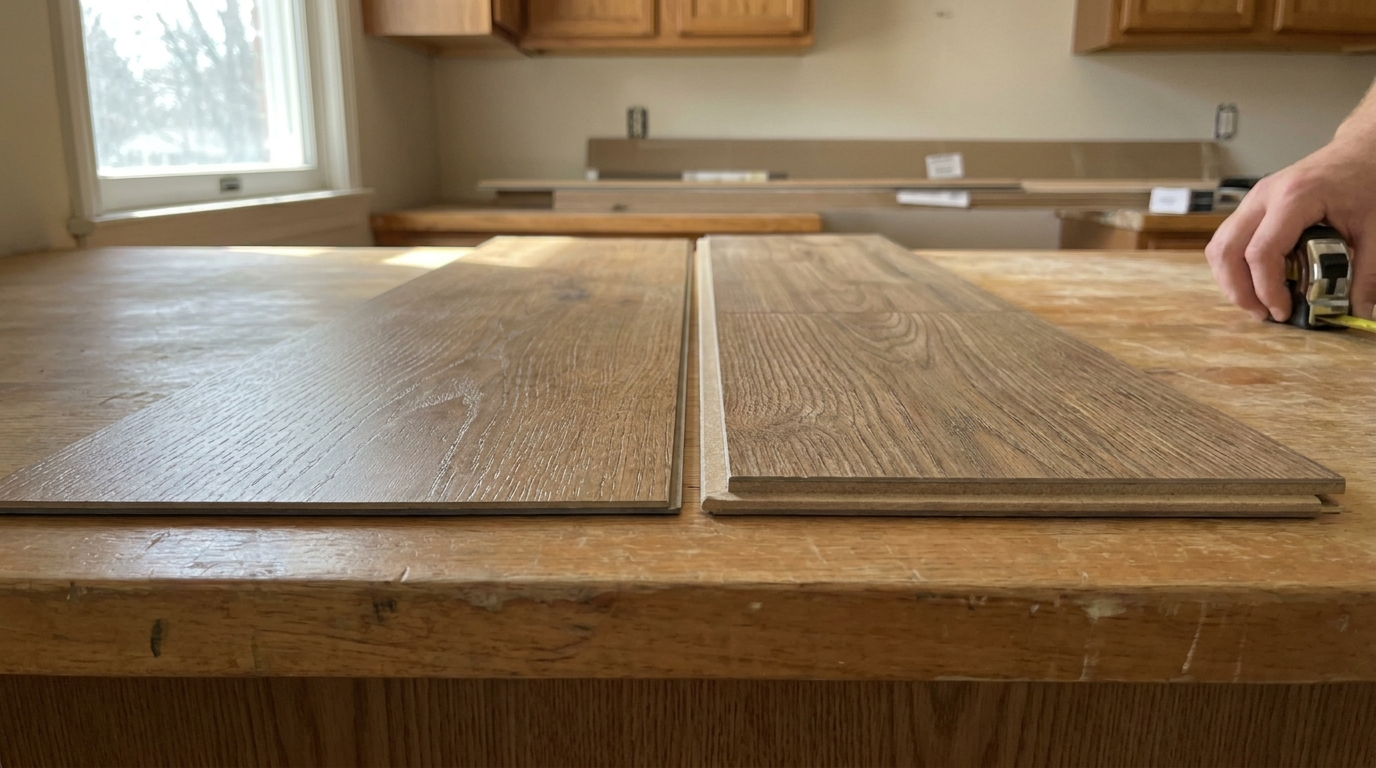
Laminate is a photo layer bonded over a fiberboard core. It looks convincing, installs fast, and costs less at the material level. But fiberboard swells when it gets wet, and once that happens, the damage isn’t repairable. A kitchen sink overflow or a slow leak under a dishwasher can ruin a laminate floor in a way that’s expensive to fix.
LVP is a different construction entirely: a printed vinyl layer over a rigid or flexible core that’s genuinely waterproof, not just water-resistant. Spills, pet accidents, and the occasional flood don’t damage it the way they damage laminate.
That single difference is why LVP has become the default recommendation for kitchens, bathrooms, mudrooms, and basements, while laminate holds up fine in bedrooms, living rooms, and other low-moisture spaces where its slightly lower material cost can matter on a budget-conscious job.
Comparing the real numbers
Material cost. Laminate material runs $1-$5 per square foot. LVP material runs $3-$7 per square foot. Laminate wins here, sometimes by a meaningful margin on a large job.
Installed cost. Laminate installed runs $4-$14 per square foot. LVP installed runs $5-$12 per square foot. The gap narrows or reverses once labor is included, because LVP’s click-lock or glue-down systems are often just as fast to install as laminate’s.
Installation speed. Laminate installs at 200-400 square feet per day. LVP installs at 200-500 square feet per day. Both are fast compared to hardwood or tile, and the exact speed depends more on subfloor prep and room layout than on the material itself.
Durability in wet conditions. Laminate is not waterproof and can swell or delaminate with sustained moisture exposure. LVP is fully waterproof and holds up to spills, humidity, and even standing water for reasonable periods.
Resale perception. Hardwood-look LVP has closed most of the visual gap with laminate, and in higher price points, some LVP is difficult to distinguish from real wood at a glance. Neither material carries the resale value of solid hardwood, but LVP tends to be viewed slightly more favorably by buyers who know what they’re looking at.
Feel underfoot. Laminate sits directly on a foam underlayment and can feel slightly harder and more hollow when walked on. LVP, especially rigid-core products, tends to feel a bit more substantial, though this varies by product line and thickness.
Where each one actually makes sense
Recommend laminate for bedrooms, home offices, and living rooms in homes where budget is the primary constraint and moisture isn’t a realistic concern. It’s also a reasonable choice for a quick flip or rental refresh where the flooring doesn’t need to survive a decade of heavy use.
Recommend LVP for kitchens, bathrooms, laundry rooms, basements, and any home with pets or young kids where spills are a matter of when, not if. It’s also the safer default for whole-home flooring jobs where you want one material throughout without worrying about moisture zones.
For a homeowner who’s genuinely torn, the deciding question is usually simple: is there any plumbing, cooking, or a dog within twenty feet of this floor. If yes, LVP earns its slightly higher material cost by avoiding a much larger repair bill down the line.
Pricing a job with either material
The formula doesn’t change based on which material you’re installing:
Price = (Materials + Labor) × (1 + Markup%)What changes is the material cost per square foot feeding into that formula, and the waste factor, which runs about the same for both (10% for standard layouts, 15% for diagonal patterns).
For a 300 square foot living room in laminate at $2.50/sq ft material and a $300 day rate for roughly a half-day of labor, direct costs land around $900. The same room in LVP at $4/sq ft material comes to roughly $1,200 in direct costs, with labor staying similar since installation speed is comparable.
That $300 difference on a 300 square foot room is a reasonable number to walk a homeowner through directly: “laminate saves you about a dollar a square foot, but it’s not something I’d put in a kitchen.”
What contractors get wrong when quoting these jobs
Quoting laminate for a kitchen or bathroom without flagging the risk. Some homeowners will choose it anyway for budget reasons, which is their call, but it should be an informed one, not an oversight.
Treating LVP as one product. Rigid-core, flexible/SPC, and glue-down LVP have different price points and installation methods. Confirm which type before pricing the labor, since glue-down installs slower than click-lock.
Ignoring underlayment differences. Laminate almost always needs a foam underlayment for sound and comfort. Some LVP products have it built in, which changes your material list and cost.
Assuming the cheaper material is always the better bid. A homeowner comparing your LVP quote to a competitor’s laminate quote isn’t comparing equivalent jobs, and it’s worth explaining that clearly rather than just losing the bid on price.
FAQ
Is vinyl plank or laminate cheaper?
Laminate material is generally cheaper, running $1-$5/sq ft versus $3-$7/sq ft for LVP. Installed costs are closer, with laminate at $4-$14/sq ft and LVP at $5-$12/sq ft, since installation speed is similar for both.
Which lasts longer, vinyl plank or laminate?
LVP typically lasts longer in real-world conditions because it’s waterproof and holds up better to daily wear, spills, and humidity. Laminate can last just as long in dry, low-traffic areas but is vulnerable to any sustained moisture exposure.
Can laminate be installed in a bathroom?
It’s not recommended. Laminate isn’t waterproof, and bathrooms involve enough moisture exposure over time that swelling and delamination are a real risk. LVP is the safer choice for any room with plumbing.
Does LVP feel different underfoot than laminate?
Slightly. Rigid-core LVP tends to feel a bit more substantial than laminate, which sits on a foam underlayment and can feel somewhat hollow. The difference is noticeable but not dramatic, and both are more comfortable than tile.
Which one installs faster?
Both install quickly, in the 200-500 square foot per day range depending on the crew and layout. Neither has a significant speed advantage over the other; subfloor condition and room complexity matter more than the material choice.
The short version
Laminate costs a little less on materials and works fine in dry, low-traffic rooms. LVP costs a bit more but is genuinely waterproof, making it the safer default for kitchens, bathrooms, and homes with pets or kids. Price both the same way, with material cost being the main variable, and steer the homeowner’s choice based on where the floor is actually going rather than sticker price alone.
SnapScope calculates materials, labor, and markup for either material straight from your job site photos, so you can hand a homeowner both options priced out before you leave.

SnapScope AI - Cost Estimator
Snap photos. Get instant estimates.
 Download SnapScope
 Or search "SnapScope AI" in the App Store
For the full 2026 rate table across every flooring type, see the flooring pricing guide, or read how to price a flooring installation job for the complete estimating breakdown.