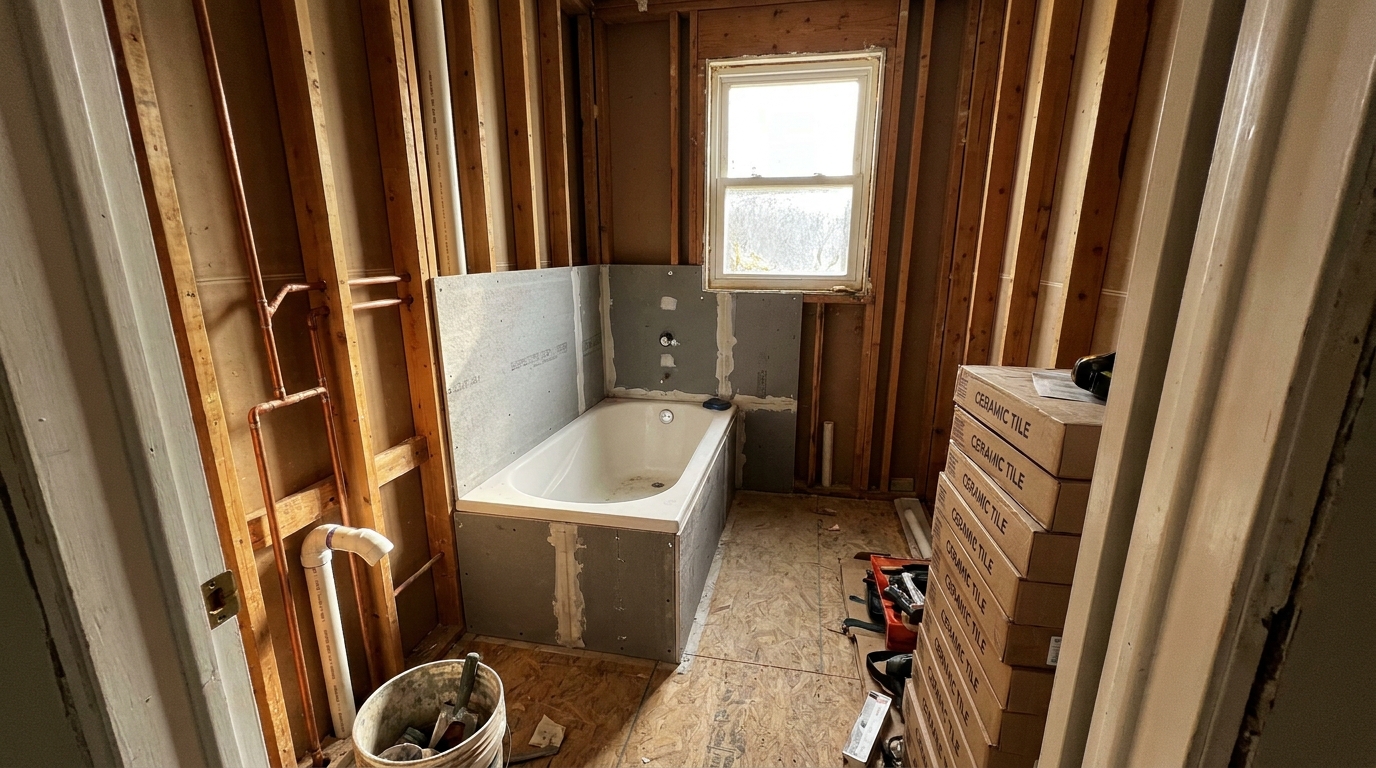
How to Price a Bathroom Remodel in 2026
How contractors should price a bathroom remodel in 2026: cost by scope, labor vs materials split, trade-by-trade line items, and a full worked example on a 5x8 gut.
A bathroom is the smallest room in the house and one of the hardest to price. Every trade shows up — demo, plumbing, electrical, tile, drywall, paint, and finish carpentry — inside about 40 square feet, in sequence, where each one waits on the last. The square footage tells you almost nothing. A 5x8 hall bath and a 5x8 primary bath with a relocated shower can differ by $15,000.
A full mid-range bathroom remodel runs $6,500-15,000 in 2026, with the national average landing $12,000-25,000 depending on how much of the room actually moves. Small bath renovations run $5,000-20,000. Primary suites run $40,000-80,000 and up.
The number that matters more than any of those: labor is 50-65% of a bathroom remodel, materials 30-45%, and permits, demo, and disposal the remaining 5-10%. If your estimate has labor under half the total, you’ve probably missed a trade.
Price by scope, not by square foot
Bathrooms sort cleanly into three tiers, and naming the tier in the conversation is the fastest way to align with a homeowner before you write anything down.
Cosmetic refresh — $3,000-8,000. Paint, new vanity, new fixtures, new mirror and lighting, maybe a new toilet. Nothing moves. No walls open, no plumbing relocates. One to two weeks.
Standard remodel — $8,000-20,000. Everything above plus new tile, a new tub or shower surround, and new flooring. Plumbing stays where it is. Two to four weeks.
Full gut — $20,000-50,000+. Down to studs, layout changes, relocated plumbing, possibly moving a wall. Four to eight weeks. This is where the surprises live.
The single biggest cost driver isn’t finish level, it’s whether the plumbing moves. Keeping the toilet, sink, and shower drain in place versus relocating them is often a $5,000-10,000 swing on its own, because relocation means opening floors, rerouting drain lines with correct fall, and coordinating inspections.
The trade-by-trade breakdown
Build the estimate as a sum of trades, not as a lump sum with a markup on top. This is what lets you defend the number and lets the homeowner cut scope intelligently.
| Line item | Typical range |
|---|---|
| Demolition and disposal | $1,000 – $2,300 |
| Plumbing rough-in | $3,000 – $8,000 |
| Electrical | $800 – $2,500 |
| Tile installation labor | $2,500 – $6,000 |
| Permits (plumbing + electrical stack separately) | $100 – $1,000 |
| GC overhead and supervision | 10 – 20% of project |
Trade labor rates in 2026:
| Trade | Rate |
|---|---|
| Plumber | $85 – $175/hr |
| Electrician | $60 – $145/hr |
| Tile installer | $12 – $22/sq ft of tile |
Material ranges worth knowing by heart, because this is where homeowners make choices that swing the total:
| Material | Range |
|---|---|
| Ceramic tile | $1 – $15/sq ft |
| Natural stone (marble etc.) | $20 – $50+/sq ft |
| Vanity | $200 (builder grade) – $2,000+ (custom) |
| Toilet | $100 – $800 |
| Shower/tub fixtures | $50 – $500+ |
Tile is where the spread gets dangerous. The same shower surround in $2/sq ft ceramic versus $35/sq ft marble is a several-thousand-dollar difference in material, and the marble also installs slower, so labor rises with it. Never quote tile as an allowance without naming a per-square-foot number.
Allowances are how you survive the selection process
Most bathroom quotes go out before the homeowner has picked a single tile. The professional way to handle that is explicit allowances: “$8/sq ft tile allowance,” “$600 vanity allowance,” “$300 fixture allowance.”
Write the allowance number into the contract as a line item, and state plainly that selections above it are a change order at cost plus your markup. This does two things. It lets you quote before selections are final, and it turns the inevitable upgrade conversation into arithmetic instead of an argument.
The failure mode without allowances is predictable: you priced builder-grade in your head, they picked the marble they saw on Instagram, and now you’re eating $4,000 or having an uncomfortable conversation in week three.

SnapScope AI - Cost Estimator
Snap photos. Get instant estimates.
 Download SnapScope
 Or search "SnapScope AI" in the App Store
A worked example: 5x8 hall bath, full gut, plumbing stays put
40 square feet of floor. Tub-shower combo, single vanity, toilet. Down to studs, but fixtures stay in their existing locations. 1990s build, so no asbestos or lead concerns. Mid-range finishes.
Demo and disposal. Tub, tile, vanity, flooring, drywall to studs, plus dumpster: $1,600.
Plumbing. No relocation, but new supply lines, new tub/shower valve, new drain connections, and reset all three fixtures. Roughly 14 hours at $110/hr: $1,540. Note this is well below the $3,000-8,000 rough-in range precisely because nothing moves — that range assumes relocation.
Electrical. New GFCI, exhaust fan with new duct run, vanity light, recessed can over the shower. Roughly 10 hours at $95/hr plus $250 in materials: $1,200.
Drywall. Cement board in the wet area, moisture-resistant board elsewhere, Level 4 finish over roughly 320 sq ft of wall and ceiling at $2.40/sq ft: $770.
Tile. 40 sq ft floor plus 110 sq ft of tub surround = 150 sq ft. Labor at $16/sq ft: $2,400. Tile material at an $8/sq ft allowance plus setting materials: $1,400. Total $3,800.
Fixtures and finishes. Tub $500, vanity with top $900, toilet $350, faucet and shower trim $450, mirror, lighting, accessories $400: $2,600.
Paint. Ceiling and remaining walls: $400.
Permits. Plumbing and electrical: $350.
Direct costs: $12,260. At a 20% GC markup for supervision, coordination, and scheduling seven trades in sequence: $14,700.
That lands in the upper half of the standard remodel range, which is right for a full gut. Worth noticing what’s not in this number: no wall moved, no plumbing relocated, no tile above $8/sq ft, and no surprises behind the walls. Every one of those is a real possibility, which is why the next section matters.
Where bathroom remodels go wrong
Not pricing the discovery. You can’t see rot, failed subfloor, previous unpermitted work, or corroded supply lines until demo. In any home over 30 years old, either carry a 10-15% contingency or write an explicit exclusion covering concealed conditions. Never absorb it silently.
Quoting without allowances. Selections drift upward. Always. Allowances make that a change order instead of a loss.
Underestimating coordination. Seven trades in a 40-square-foot room, each waiting on the one before, with inspections between. That sequencing is real work, and it’s what the 10-20% GC markup pays for. Solo operators routinely forget to charge for it because it doesn’t feel like “work.”
Missing the ventilation. Code generally requires exhaust venting to the exterior. Older bathrooms frequently vent into an attic or nowhere at all. Discovering that mid-job means a new duct run, and possibly a roof or soffit penetration.
Pricing tile by area and ignoring pattern. Herringbone, mosaic, and large-format tile all install slower than a straight lay. Same square footage, meaningfully different labor.
Forgetting the homeowner loses a bathroom. If it’s their only one, the timeline pressure is intense and every delay is a conflict. Price and schedule that reality honestly rather than promising two weeks and delivering four.
Regional blindness. Labor is the largest regional variable, and the same project can cost 30-40% more in a coastal urban market than in the Midwest. Rate tables from a national article aren’t your market — calibrate them against your own last three jobs.
FAQ
How much does a bathroom remodel cost in 2026?
A full mid-range bathroom remodel runs $6,500 to $15,000, with the national average at $12,000 to $25,000. A cosmetic refresh runs $3,000 to $8,000, a standard remodel with new tile and fixtures runs $8,000 to $20,000, and a full gut with layout changes runs $20,000 to $50,000 or more.
What percentage of a bathroom remodel is labor?
Labor accounts for 50% to 65% of a typical mid-range bathroom remodel. Materials make up 30% to 45%, and permits, demolition, and disposal account for the remaining 5% to 10%. If labor is under half your total, you’ve likely missed a trade.
How much does it cost to move plumbing in a bathroom?
Relocating fixtures is the single biggest cost driver in a bathroom remodel, often adding $5,000 to $10,000. Plumbing rough-in runs $3,000 to $8,000 when fixtures move, versus considerably less when the toilet, sink, and shower stay in their existing locations.
How should contractors handle material selections in a bathroom quote?
Use explicit allowances written into the contract as line items — a per-square-foot tile allowance, a vanity allowance, a fixture allowance — and state that selections above those figures are a change order at cost plus markup. This lets you quote before selections are final and turns upgrades into arithmetic rather than a dispute.
What contingency should I carry on a bathroom remodel?
Carry 10% to 15% on any home over 30 years old, or write an explicit exclusion for concealed conditions. Rot, failed subfloor, corroded supply lines, and previous unpermitted work aren’t visible until demolition, and they’re common enough to plan for.
How long does a bathroom remodel take?
A cosmetic refresh takes one to two weeks, a standard remodel two to four weeks, and a full gut four to eight weeks. The timeline is driven by trade sequencing and inspections more than by the volume of work, since each trade waits on the one before it.
The short version
Price a bathroom as a stack of trades, not a square-foot rate, because the square footage barely correlates with the cost. Establish early whether the plumbing moves, since that single question is worth five figures. Use written allowances for every selection the homeowner hasn’t made yet. Carry a real contingency on older homes instead of hoping demo goes clean. And charge for coordination — sequencing seven trades through a 40-square-foot room is the actual job, and it’s the line most contractors leave off.
SnapScope turns job site photos into a priced estimate with labor, materials, and your markup built in, so you can hand over a real number before you’ve left the driveway.
For the trades inside a bathroom, see how to price a drywall job, what plumbers should charge, electrician hourly rates, and how to price flooring installation. For the math behind your markup, see markup vs. margin.