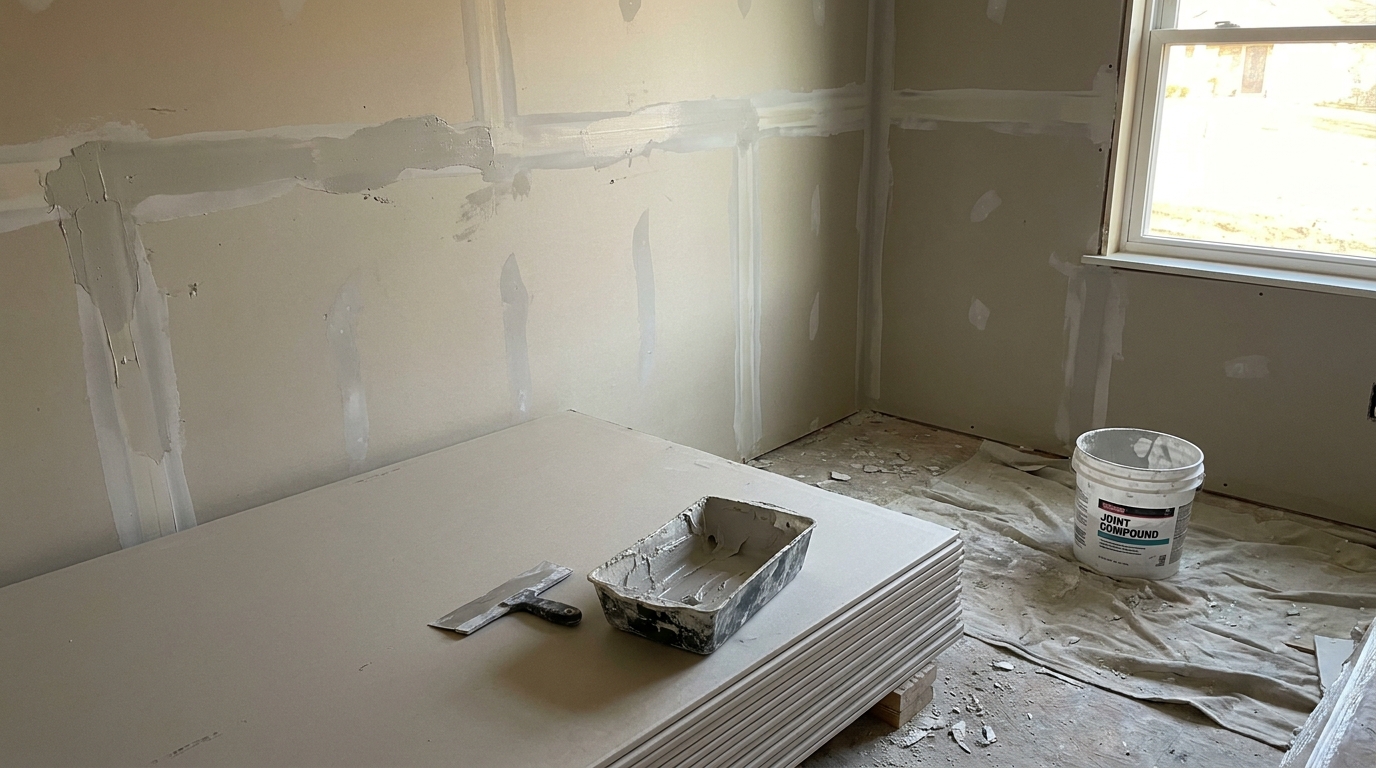
How to Price a Drywall Job in 2026 (Per Sheet or Per Square Foot)
How to price drywall hanging and finishing in 2026: per sheet vs per square foot rates, Level 0-5 finish pricing, waste factors, and a full worked example.
Drywall is easy to underbid because the slow part isn’t the part anyone pictures. Hanging board on open walls is fast and predictable. Taping, coating, sanding, and coming back between coats is where the hours go, and that’s the part that gets compressed in your head when a homeowner is standing there waiting for a number.
Installed drywall runs $1.50 to $3.50 per square foot in 2026, or $30 to $70 per 4x8 sheet hung and finished. Materials are only $0.50 to $0.80 of that. Labor is $1.00 to $2.70, which means labor is 65-75% of the job — so almost every pricing mistake in this trade is a labor estimating mistake, not a materials one.
Per sheet or per square foot
Both work. What causes problems is switching between them inside one estimate.
Per sheet is fast to count off a plan and works on open new construction with long uninterrupted runs, where each sheet does a full sheet’s worth of work. Per square foot holds up better on remodels, bathrooms, closets, and soffits, where you’re throwing away half of several sheets and the sheet count doesn’t reflect the cutting time.
If you’re unsure, price per square foot. It’s the method that punishes you less when the job turns out messier than it looked.
One counterintuitive rule from the takeoff side: don’t deduct for doors and windows when counting sheets. You’ll cut those openings out of full sheets anyway, and the offcuts rarely land anywhere useful. Multiply wall length by height, divide by 32 for 4x8 panels or 48 for 4x12, and leave the openings in.
| Scope | Cost per square foot |
|---|---|
| Materials only | $0.50 – $0.80 |
| Hang only (Level 0, no tape or mud) | $0.85 – $1.90 |
| Tape and mud only | $0.35 – $1.10 |
| Hang and finish, walls | $1.50 – $3.50 |
| Hang and finish, ceilings | $1.50 – $3.80 |
| Texture (add) | $0.80 – $2.00 |
| Old drywall removal and disposal (add) | $0.50 – $2.50 |
| Full replacement (demo + new) | $2.00 – $6.00 |
Board itself runs $10-20 per sheet, or $0.30-0.50 per square foot. Drywall contractors bill $40-100 per hour for hang and finish work.
Finish levels are the biggest variable you can control
Almost nobody outside the trade knows finish levels exist. Homeowners ask for “drywall” and picture what they saw on a renovation show, which is a Level 5. You quote Level 4. That gap is where the arguments happen.
| Level | Cost/sq ft | What it is |
|---|---|---|
| 0 | $0.85 – $1.90 | Hung, no tape or mud |
| 1 | $1.15 – $2.15 | Tape embedded only — attics, concealed spaces |
| 2 | $1.30 – $2.60 | One coat — garages, surfaces getting tile |
| 3 | $1.50 – $2.75 | Two coats — under medium to heavy texture |
| 4 | $1.70 – $3.20 | Three coats sanded — flat paint, light texture |
| 5 | $1.75 – $3.50 | Full skim coat — satin or gloss paint |
Level 4 is the residential default. Level 5 adds a skim coat across the entire surface and runs 25-40% more in finishing labor, because skim coating is slow and the people who do it well are rare.
The practical test for whether a wall needs Level 5: gloss or satin paint, or a large uninterrupted wall that catches raking light from a window. Under those conditions Level 4 seams will telegraph, and the homeowner will see it at 5pm with the sun coming in sideways.
Write the level into the quote as a line item. “Level 4 finish” in writing is the difference between a change order and an argument.
Waste and material planning
Order 10-15% over your sheet count on standard rooms, 15-20% on remodels and anything with lots of angles or openings. Running short mid-job costs more in a supply run than the extra sheets ever did.
For finishing materials, the working figures are simple: one gallon of premixed compound covers about 100 square feet, or three 4x8 sheets. Each 4x8 sheet takes 10-16 feet of joint tape. A 12x12 bedroom runs 120-250 feet of tape.
What actually moves your labor number
Ceilings. Overhead work is slower and harder, and ceiling rates run to $3.80 per square foot against $3.50 for walls. Installers charge the top of the range for anything over 8 feet.
Drying time between coats. This is the one that quietly eats margin. A 12x12 room takes 2-3 days including drying, not a day of continuous work. Three coats means at least three visits. If you’re driving 40 minutes each way and your labor estimate assumed continuous work, you’ve priced out the windshield time.
Small jobs. Contractors charge higher per-square-foot rates on small jobs, and they should. Setup, travel, and cleanup are nearly identical whether the patch takes 30 minutes or two hours. Most pros carry a $125-250 minimum just to show up, and full repair jobs land at $300-1,500+.
Older homes. Pre-1986 construction may have asbestos, pre-1978 may have lead paint. Testing runs $250-850 for asbestos and $300-600 for lead. Don’t absorb that into a per-square-foot rate — quote it as a contingency or exclude it explicitly.
Texture. A separate operation at $0.80-2.00 per square foot. Quote it as its own line, never folded into the finish rate.
Permits. Not needed for replacing existing drywall, but finishing a basement or attic or adding a new wall does require one, at $50-400.

SnapScope AI - Cost Estimator
Snap photos. Get instant estimates.
 Download SnapScope
 Or search "SnapScope AI" in the App Store
A worked example: 1,000 sq ft basement
A 1,000-square-foot basement, 8-foot ceilings, divided into a few rooms rather than open. Homeowner wants flat paint, so Level 4 is right. Moisture-resistant board is the sensible call below grade.
Sheet count. A 1,000 sq ft basement covers roughly 1,000-2,000 square feet of wall and ceiling surface, needing 45-80 sheets walls and ceilings together. Divided layout, so call it the upper middle: 65 sheets, plus 15% waste = 75 sheets.
Materials. 75 sheets of moisture-resistant board at $18 = $1,350. Compound at one gallon per three sheets, 25 gallons at $16 = $400. Tape, screws, and corner bead, roughly $200. Materials: $1,950.
Labor. Take the finished surface at 1,600 sq ft. At a mid-range blended labor rate of $1.85/sq ft for Level 4 with ceilings included, that’s $2,960.
Total: $4,910, which works out to about $3.07 per finished square foot — upper-middle of the range, which is right for a divided layout with moisture-resistant board. A basement this size typically lands somewhere between $1,500 and $7,000, so if your number falls outside that, check your surface area calculation before you send it.
Now the scenario worth planning for. The homeowner comes back and says they want satin paint on the main room walls. That’s Level 5 across maybe 600 square feet, at 25-40% more finishing labor. That’s a $300-450 change order, not a favor. Having the finish level in the original quote is what makes that conversation a two-minute one.
Where drywall contractors lose money
Quoting hang and finish as one number without naming the level. You priced Level 4, they expected Level 5, and somebody eats a skim coat.
Estimating labor as continuous work. Three coats means three visits and multiple days of drying. The calendar and the labor hours are different numbers.
Pricing patches by area. A four-square-foot hole is not four square feet of work. Use a minimum.
Flat-rating walls and ceilings the same. Ceilings are slower, and the published rates reflect that.
Absorbing texture into the finish rate. At $0.80-2.00 per square foot, texture can be half again the cost of the finish underneath it.
Not excluding asbestos and lead in older homes. Testing alone can run $850, and remediation is $7-15 per square foot. That’s not a line you discover mid-job.
FAQ
How much does it cost to install drywall per square foot?
Drywall installation costs $1.50 to $3.50 per square foot installed in 2026, covering materials and labor for hanging, taping, and finishing. Materials account for $0.50 to $0.80 of that, and labor makes up 65% to 75% of the total.
How much should I charge per sheet of drywall?
Hanging and finishing drywall runs $30 to $70 per 4x8 sheet, depending on panel size, type, and finish level. Per-sheet pricing works best on open new construction; per-square-foot pricing is more accurate on remodels with lots of cuts.
What is the difference between a Level 4 and Level 5 drywall finish?
Level 4 is tape plus three coats of compound sanded smooth, and it’s the standard for flat paint and light texture. Level 5 adds a full skim coat across the entire surface, required for satin or gloss paint and walls with raking light. Level 5 typically costs 25% to 40% more in finishing labor.
How much does it cost to hang drywall without finishing?
Hanging only, with no taping or mudding, runs $0.85 to $1.90 per square foot. That’s a Level 0 finish. Taping and mudding separately runs $0.35 to $1.10 per square foot.
How much should I charge for a small drywall repair?
Most contractors charge a $125 to $250 minimum just to show up, with full repair jobs running $300 to $1,500 or more. The cost is driven by travel, setup, return trips for each coat to dry, and cleanup, not by the square footage of the patch.
How much joint compound do I need per sheet of drywall?
One gallon of premixed joint compound covers about 100 square feet, or three 4x8 sheets. Each 4x8 sheet also takes 10 to 16 feet of joint tape.
Do you charge more for drywall on ceilings?
Yes. Ceiling installation runs $1.50 to $3.80 per square foot against $1.50 to $3.50 for walls, and installers charge at the top of that range for ceilings over 8 feet, because overhead hanging and finishing is slower and physically harder.
The short version
Price per square foot on remodels and per sheet on open new construction, but don’t mix the two in one estimate. Name the finish level in writing, because Level 4 and Level 5 are different jobs and the homeowner can’t tell until the light hits the wall. Estimate labor against the calendar, not just the hours — three coats means multiple trips. And put a minimum on patch work, because setup and travel don’t scale down with the size of the hole.
SnapScope turns job site photos into a priced estimate with labor, materials, and your markup built in, so you can hand over a real number before you’ve left the driveway.
For pricing the trades around drywall, see how to price a painting job per square foot and the markup vs. margin math contractors get wrong. If you’re comparing tools, we broke down the best estimating apps for contractors in 2026.